Why EDGAR is the cleanest lead source for real estate capital outreach
EDGAR is the SEC's public database of every registered filing made by any company doing business with US investors. For an agency selling to real estate sponsors, the relevant form is the Form D, filed every time a sponsor raises money under Regulation D, almost always under 506(b) or 506(c).
Every Form D names the issuing firm, its address, its phone number, the signatory who legally certified the filing, and every Related Person with a meaningful role. The fields are structured. The data is free. The filings are filed continuously. A weekly EDGAR pull is the cheapest, freshest source of qualified real estate sponsor leads on the internet.
Verified active sponsors
If a firm filed a Form D last week, they raised real capital last week. Zero list-rental noise, zero outdated entries, zero scraped junk.
Annual Reg D issuance
Per SEC's most recent Capital Raising Report, total Regulation D capital raised in the US runs well over $3 trillion per year. Real estate is the largest single category by filing count.
Filing window
Sponsors must file Form D within 15 days of first sale. A new filing means new capital raised, which means new budget for service providers right now.
From sec.gov to a clean CSV of real-estate sponsor leads
Each screenshot below was built from real EDGAR data pulled live from sec.gov. The chrome, column headers, and field names match the live site exactly. Real CIKs, real filings, real issuer names.
Open EDGAR
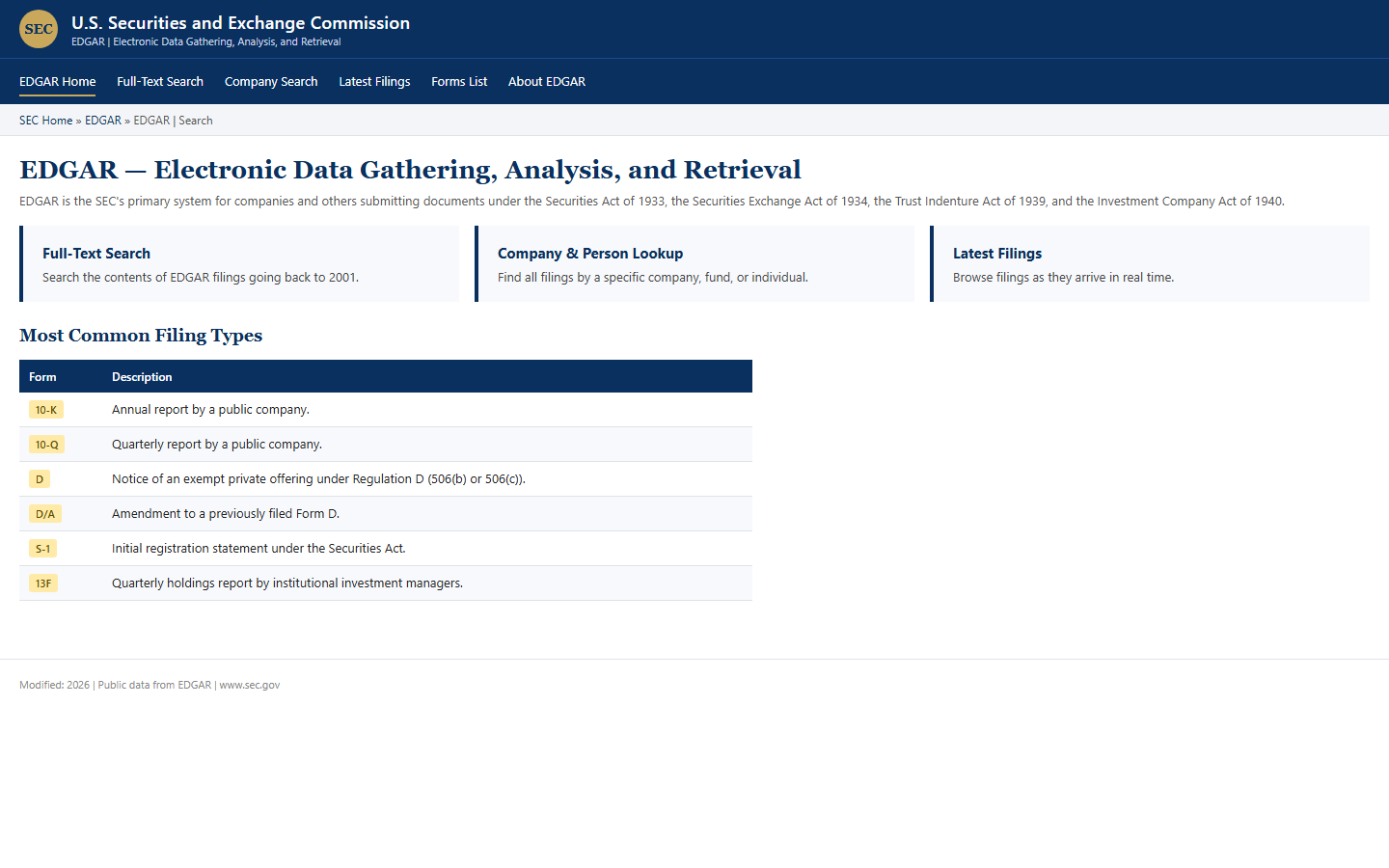
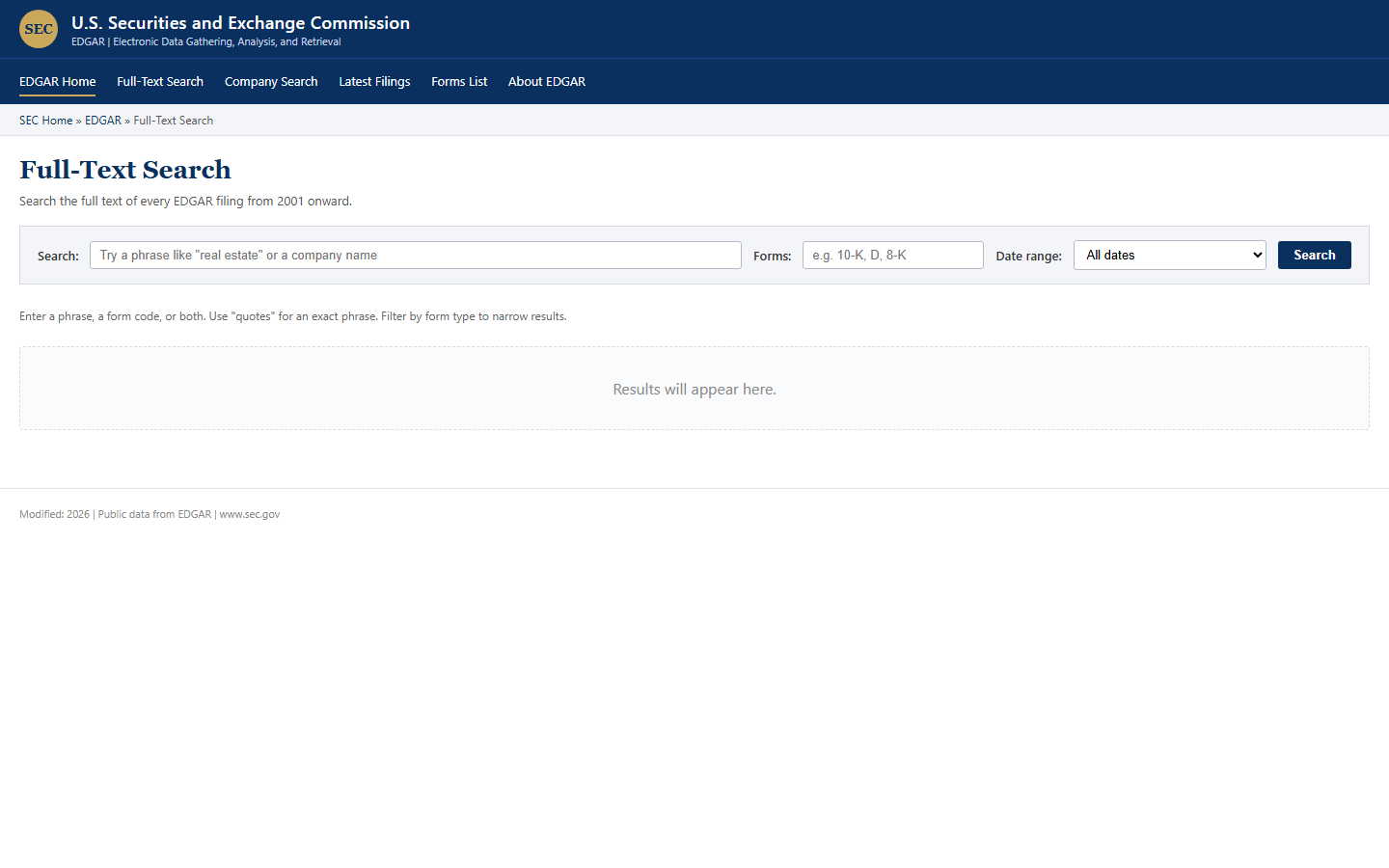
Open Full-Text Search
Filter to Form D only
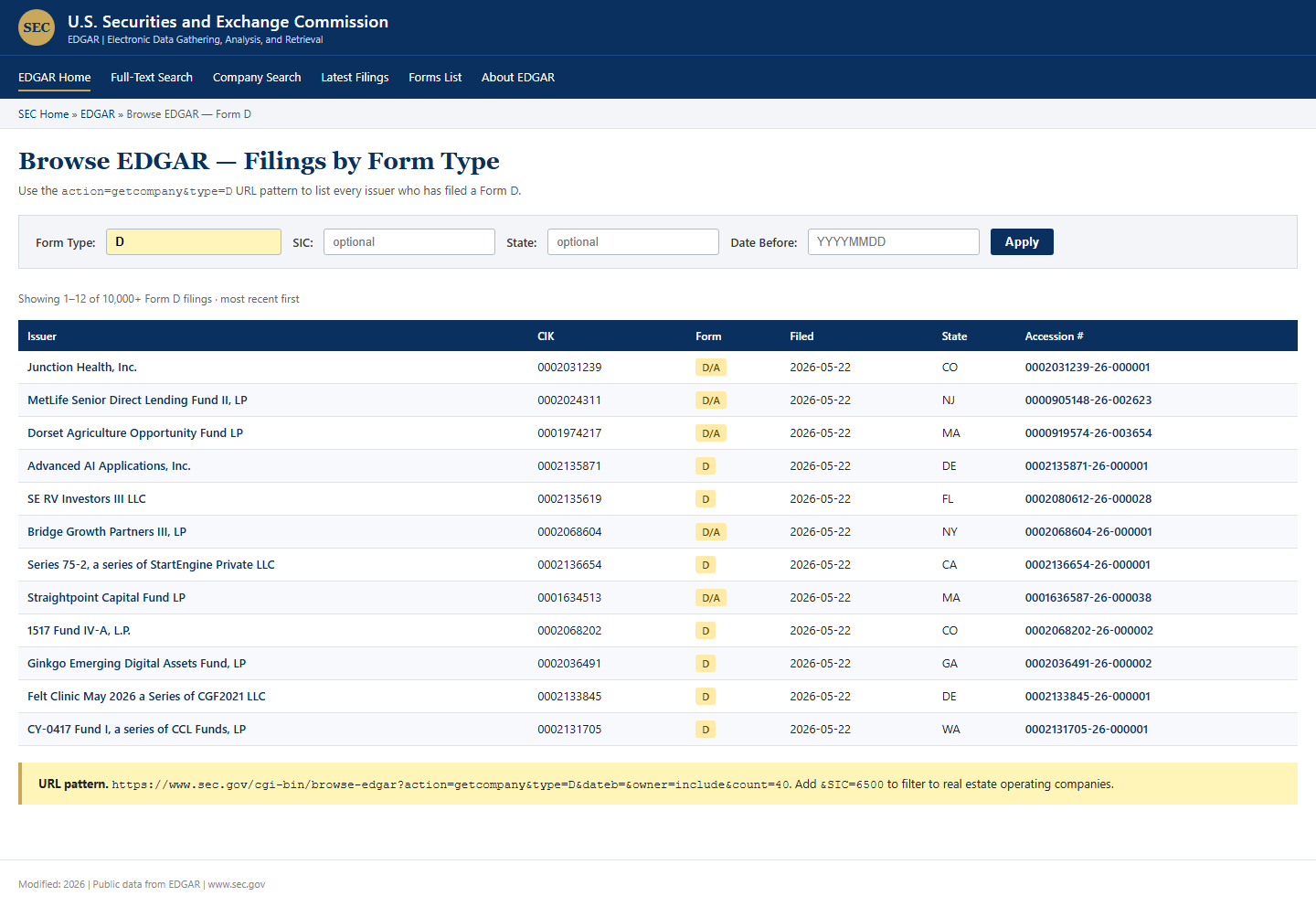
D in the Forms field. The results collapse to roughly 10,000+ Form D filings sorted by most recent. That is the universe of every Accredited Investor-only private offering filed in the US. Real estate, venture capital, private equity, hedge funds, and oil-and-gas all live in this list. The next filter strips out everything except real estate.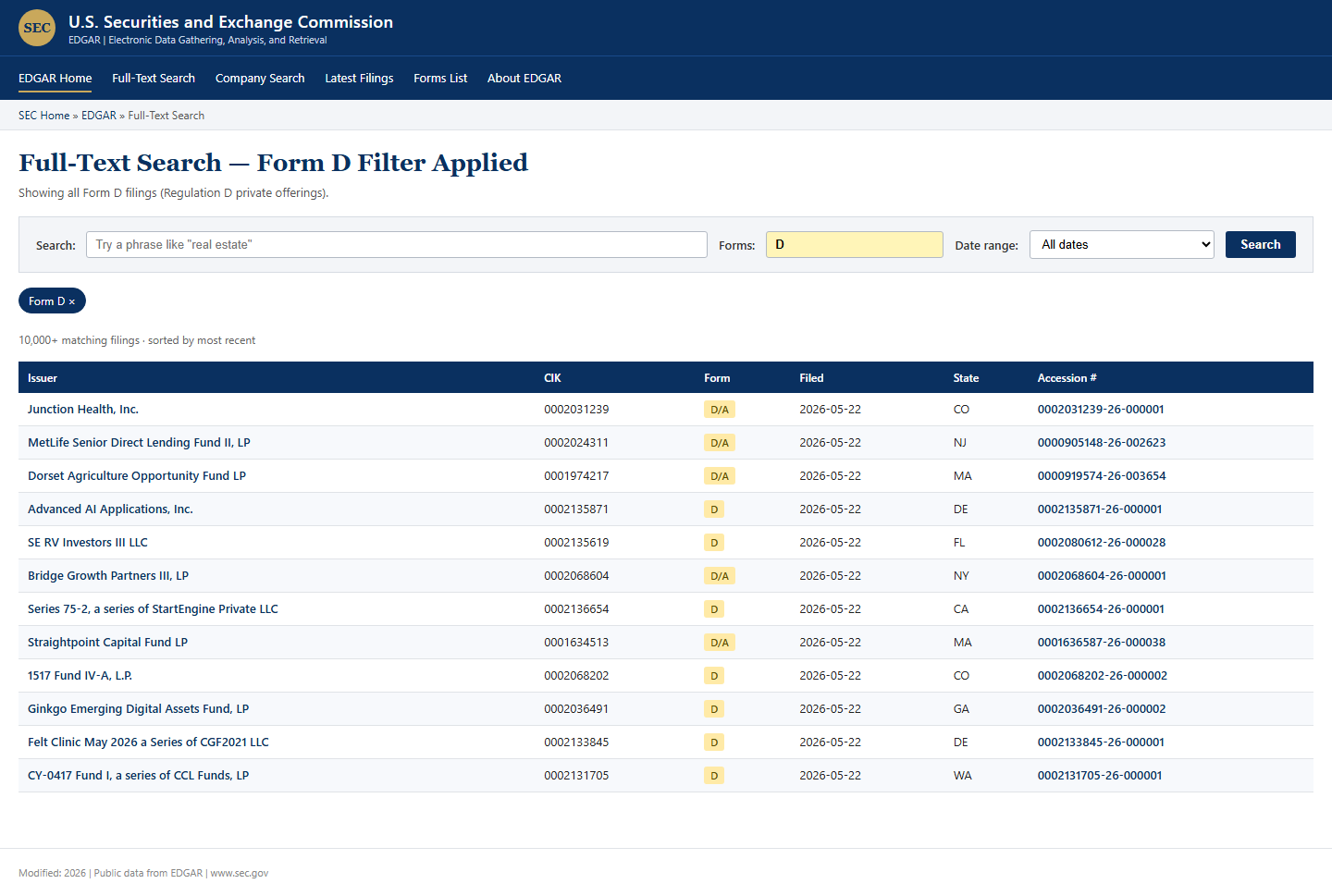
Add the "real estate" keyword
"real estate" in quotes in the search box. The quotes force exact phrase matching, which keeps the results clean. The Form D field stays at D. The result is every Form D filing whose actual filing text mentions real estate, which is almost always a real estate operator, fund, or syndication SPV.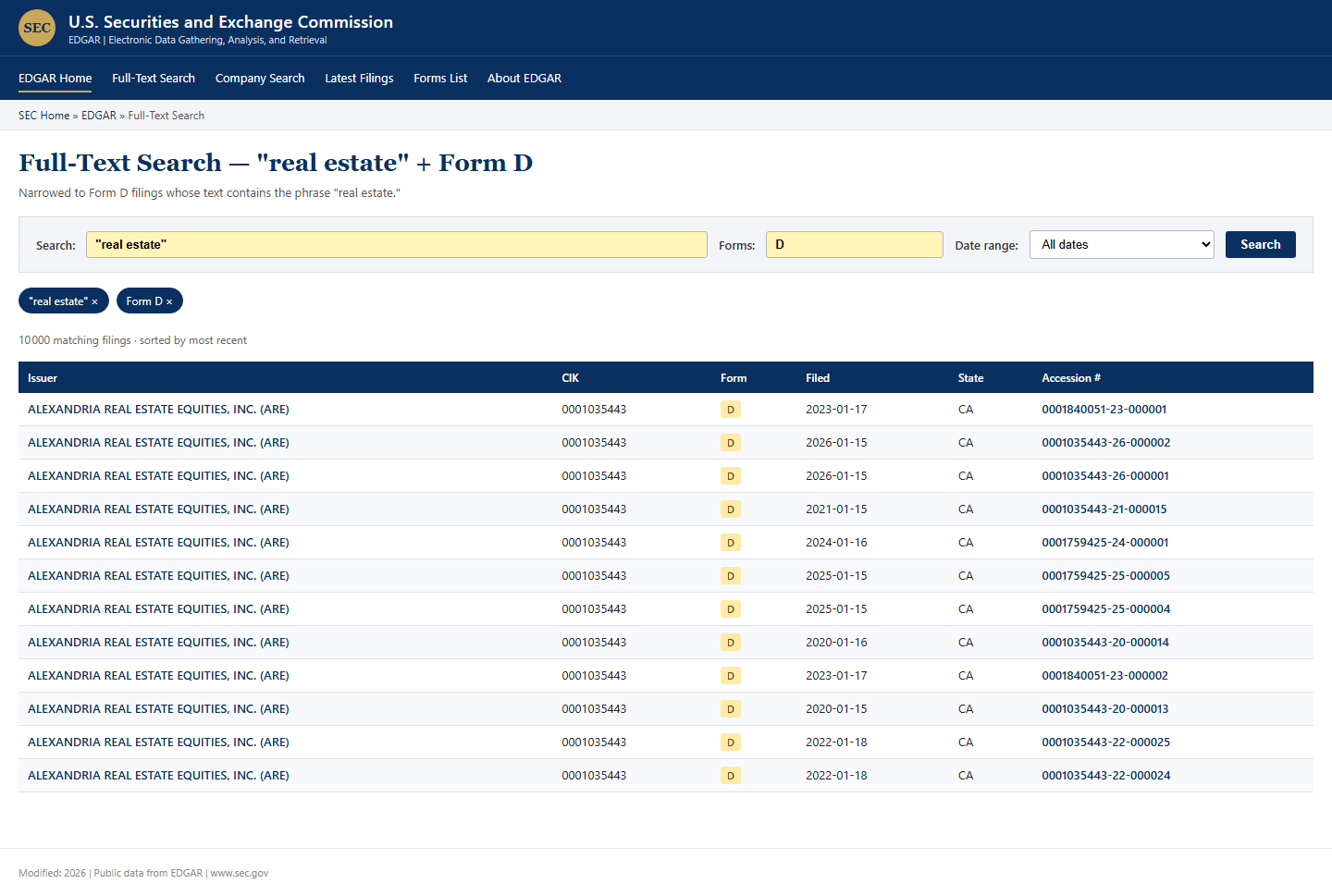
real estate without quotes also matches "real" and "estate" separately, which adds tens of thousands of unrelated filings (estate planning, real assets in fixed income, etc).Read the results list
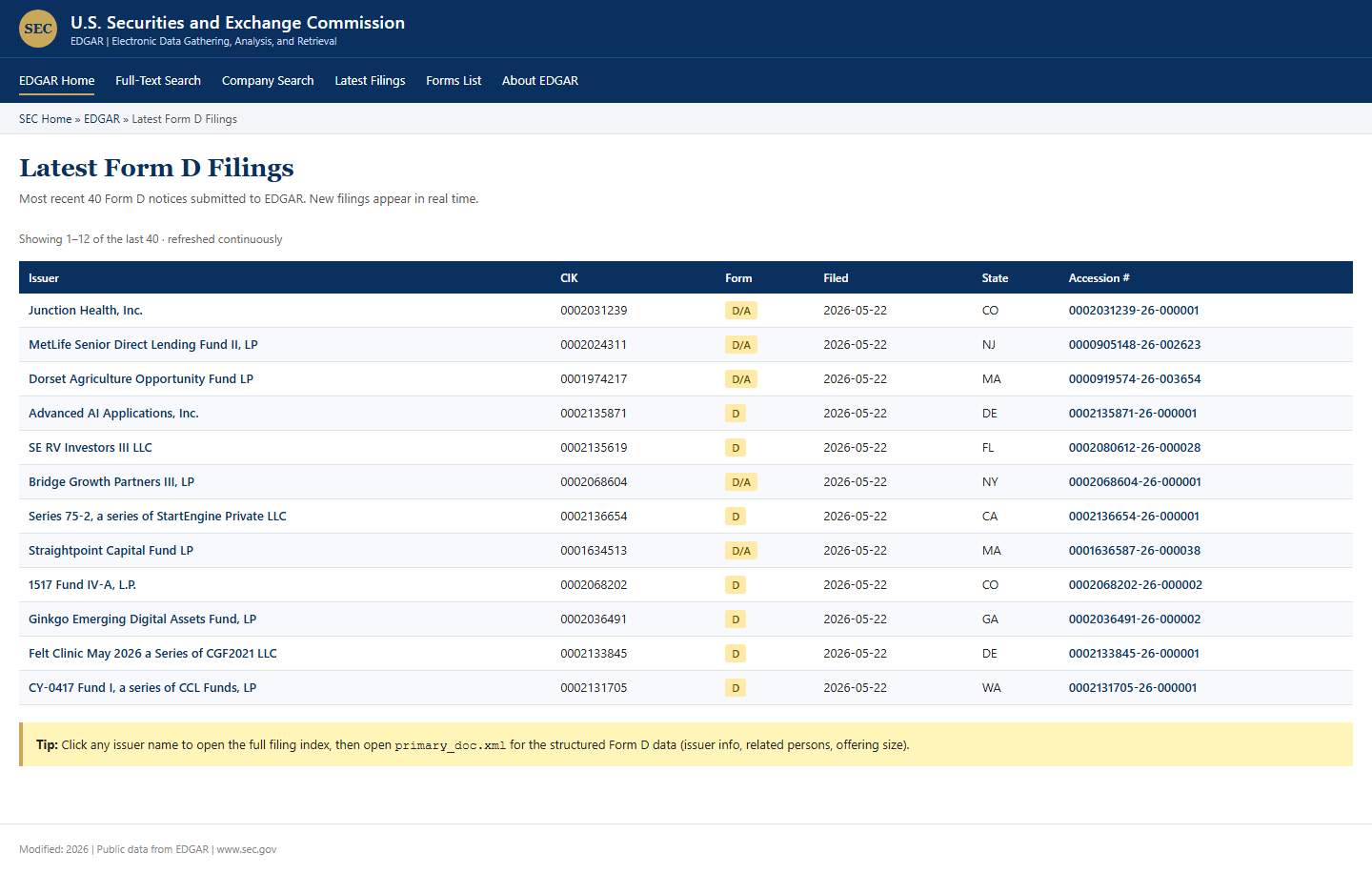
Open a filing's document index
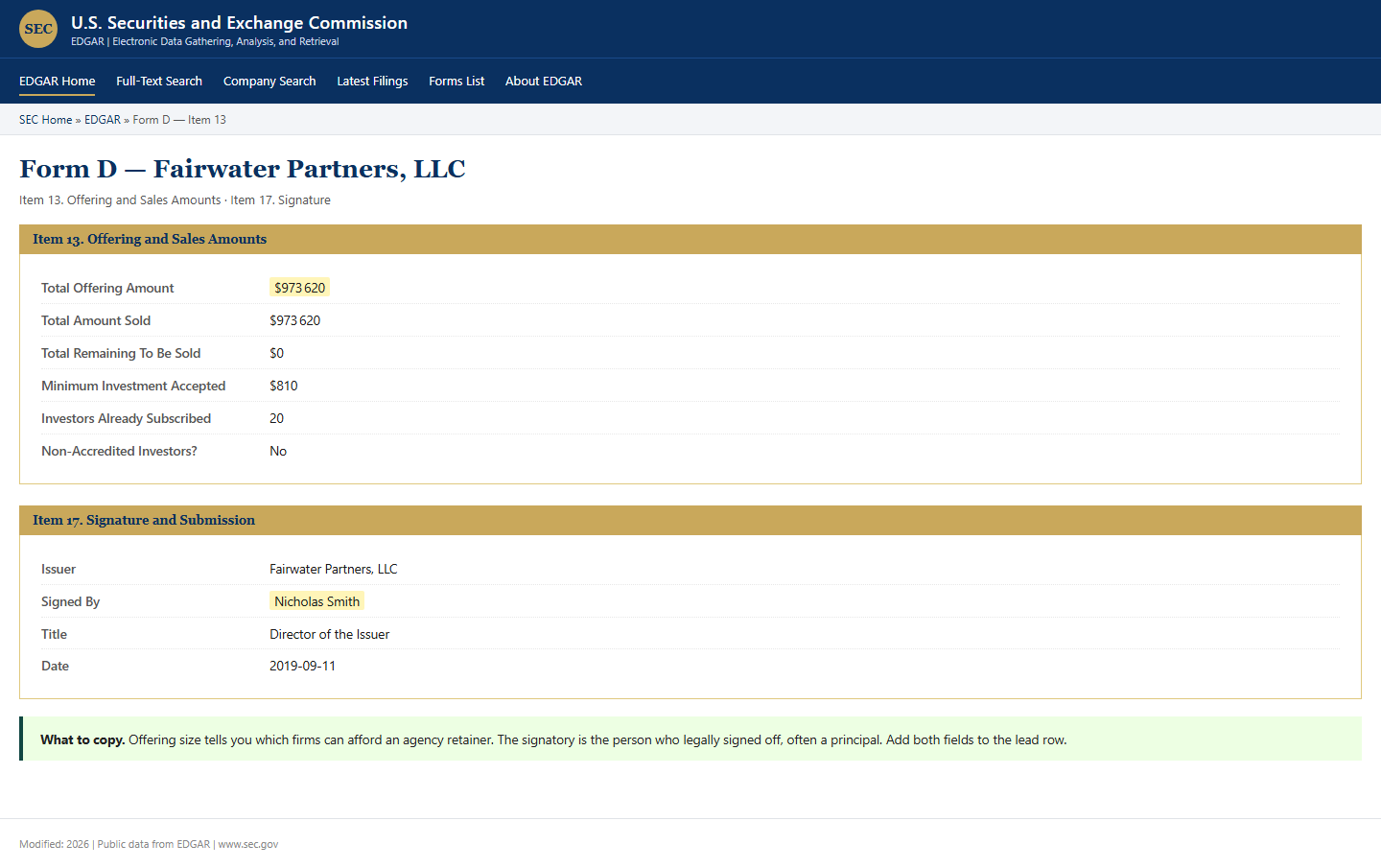
primary_doc.xml. That file holds every structured field: issuer details, related persons, industry group, offering amounts, and signature block.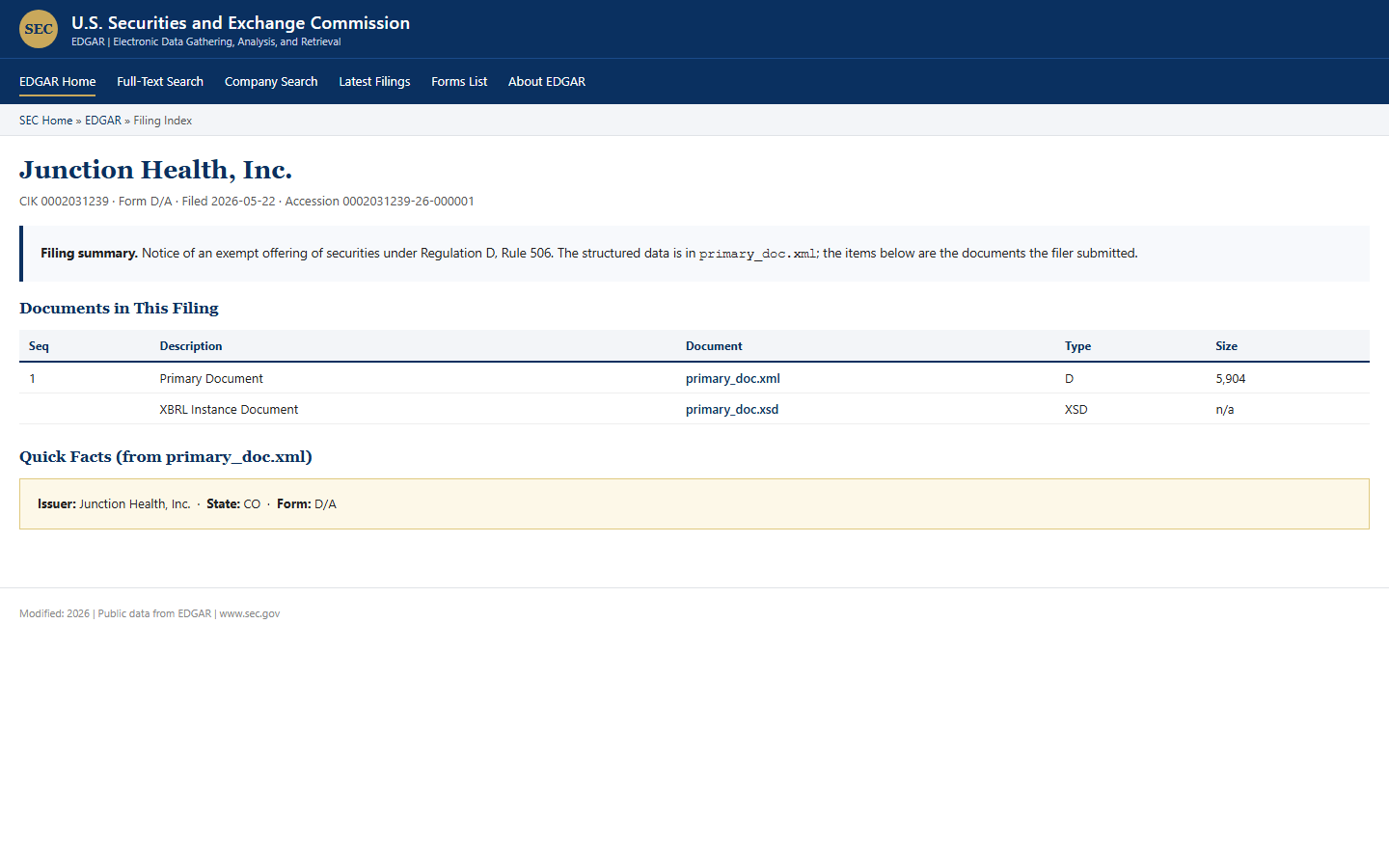
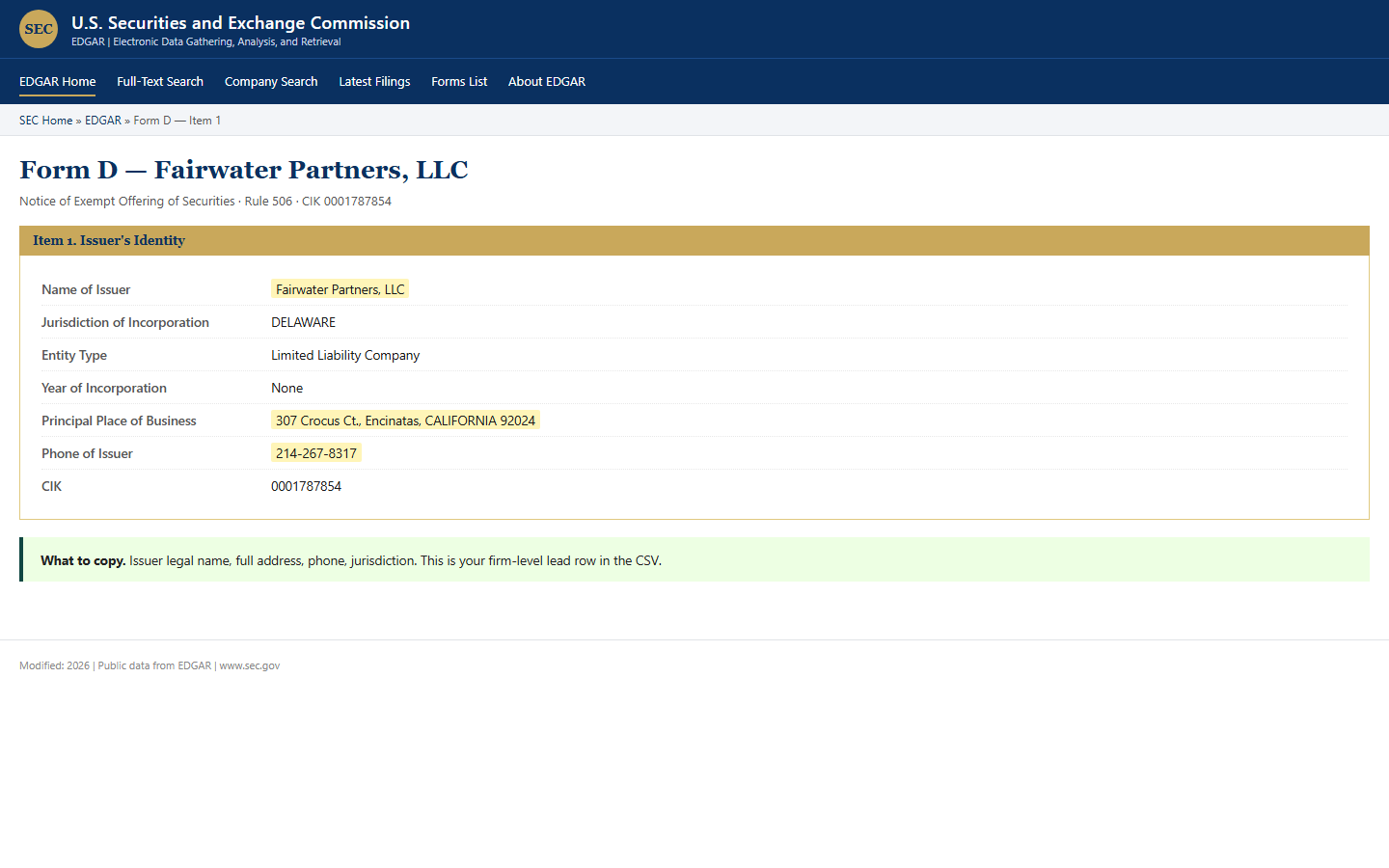
Item 1. Issuer Identity
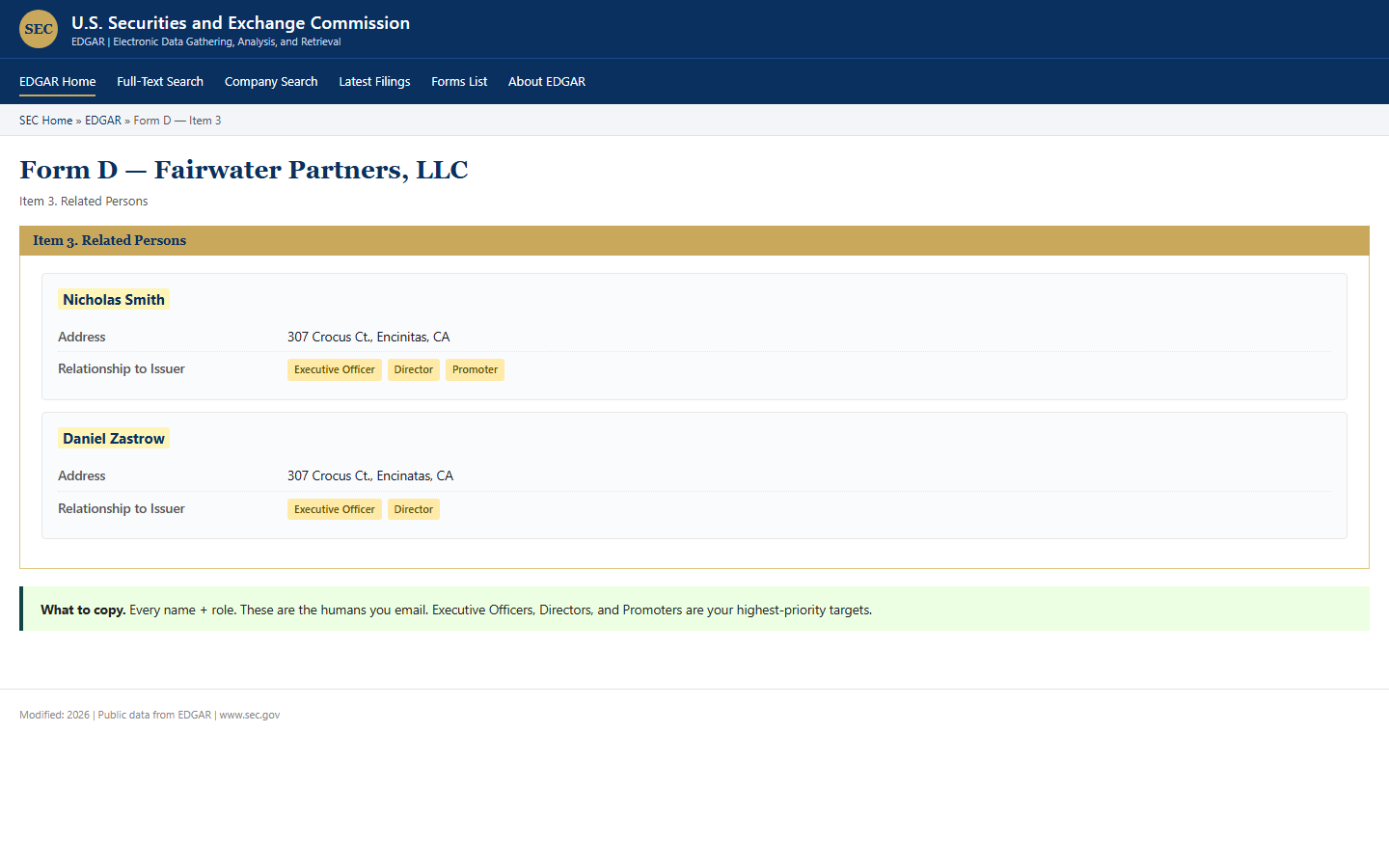
Item 3. Related Persons
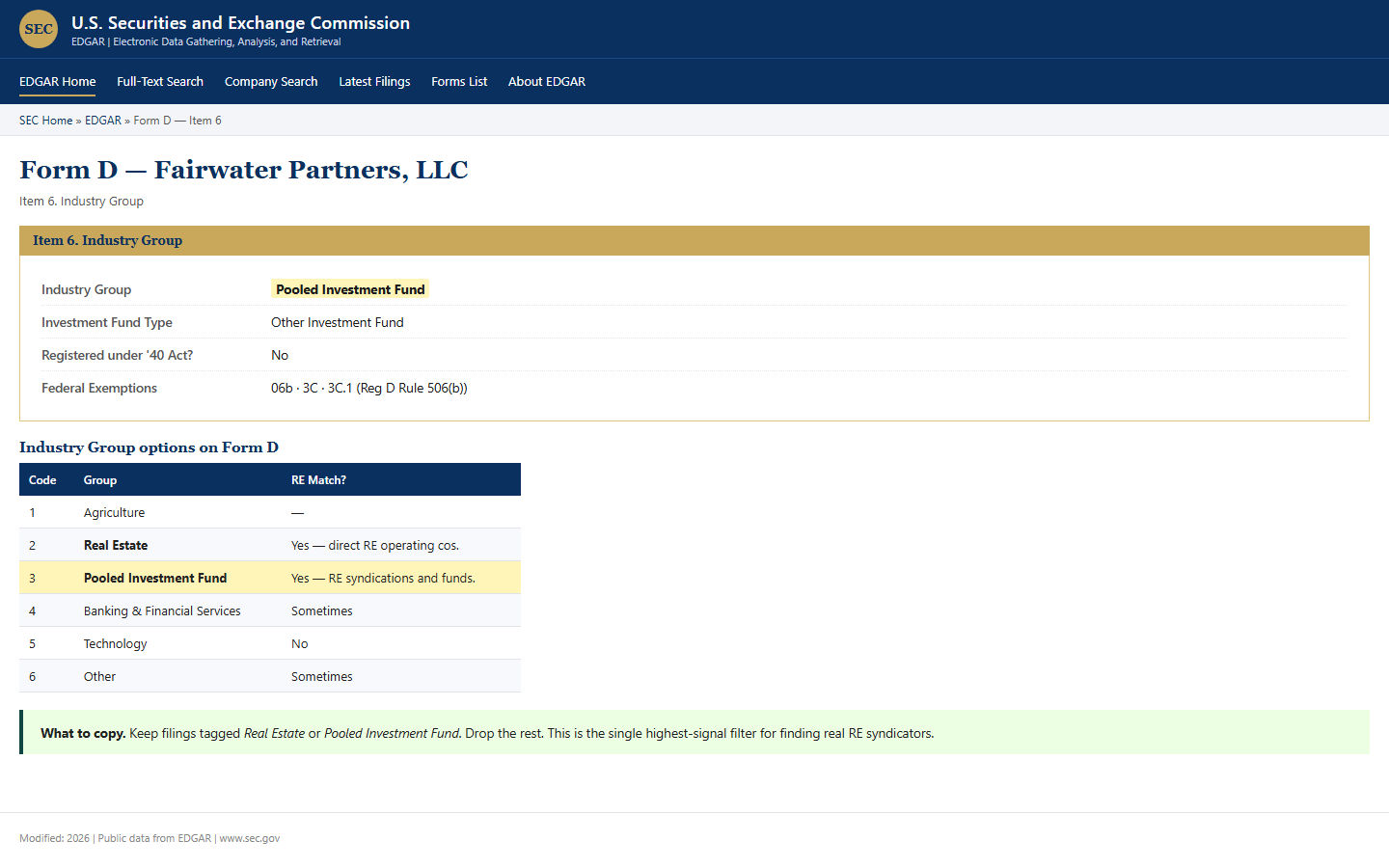
Item 6. Industry Group
Item 13. Offering and Sales
Open the browse-edgar form path
Filter by SIC 6500
&SIC=6500 to the URL. SIC stands for SIC code, and 6500 is the root code for Real Estate. The subcodes inside the 6500 family cover operators of buildings (6512), subdividers and developers (6552), and real estate investment trusts (6798). Combining the SIC filter with the Form D filter gives you the cleanest possible cut of the data set.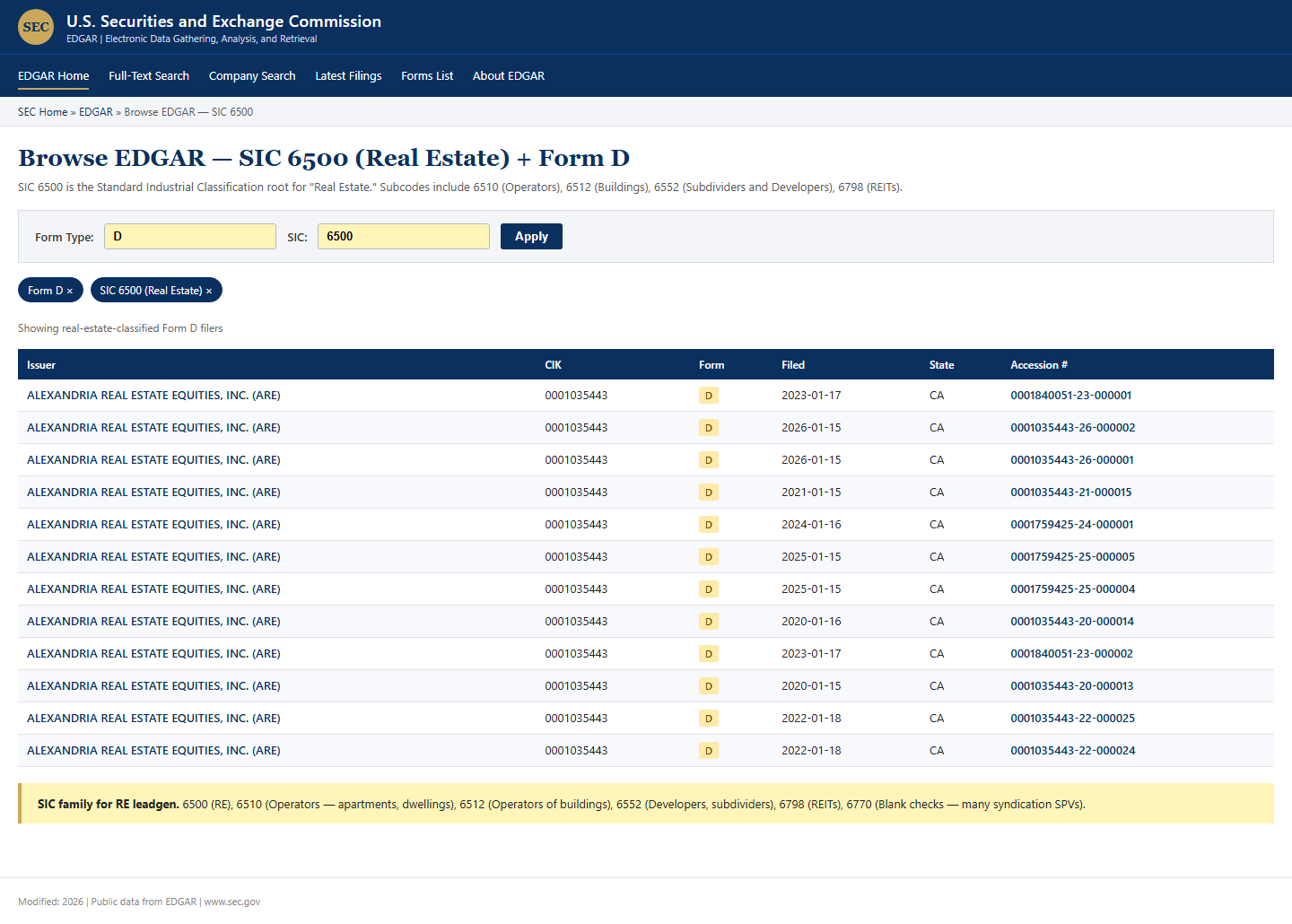
Drill into a specific sponsor's CIK page
/cgi-bin/browse-edgar?action=getcompany&CIK=XXXXXXXXXX. The page lists every filing the firm has ever made: Form Ds, amendments, and any other SEC submissions. Multiple filings often mean multiple SPVs, multiple offerings, and multiple sets of related persons to scrape.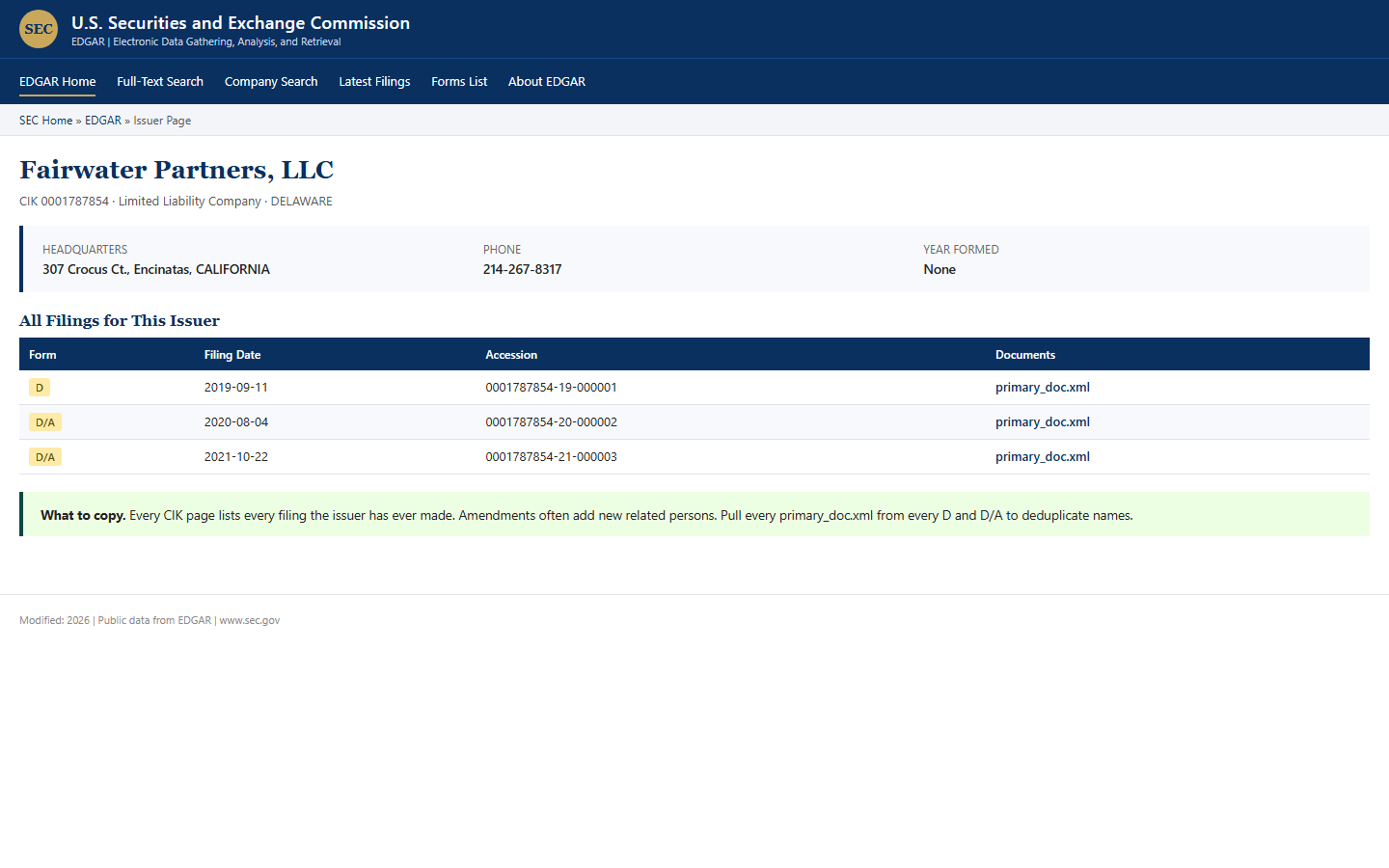
Pull the last 30 days only
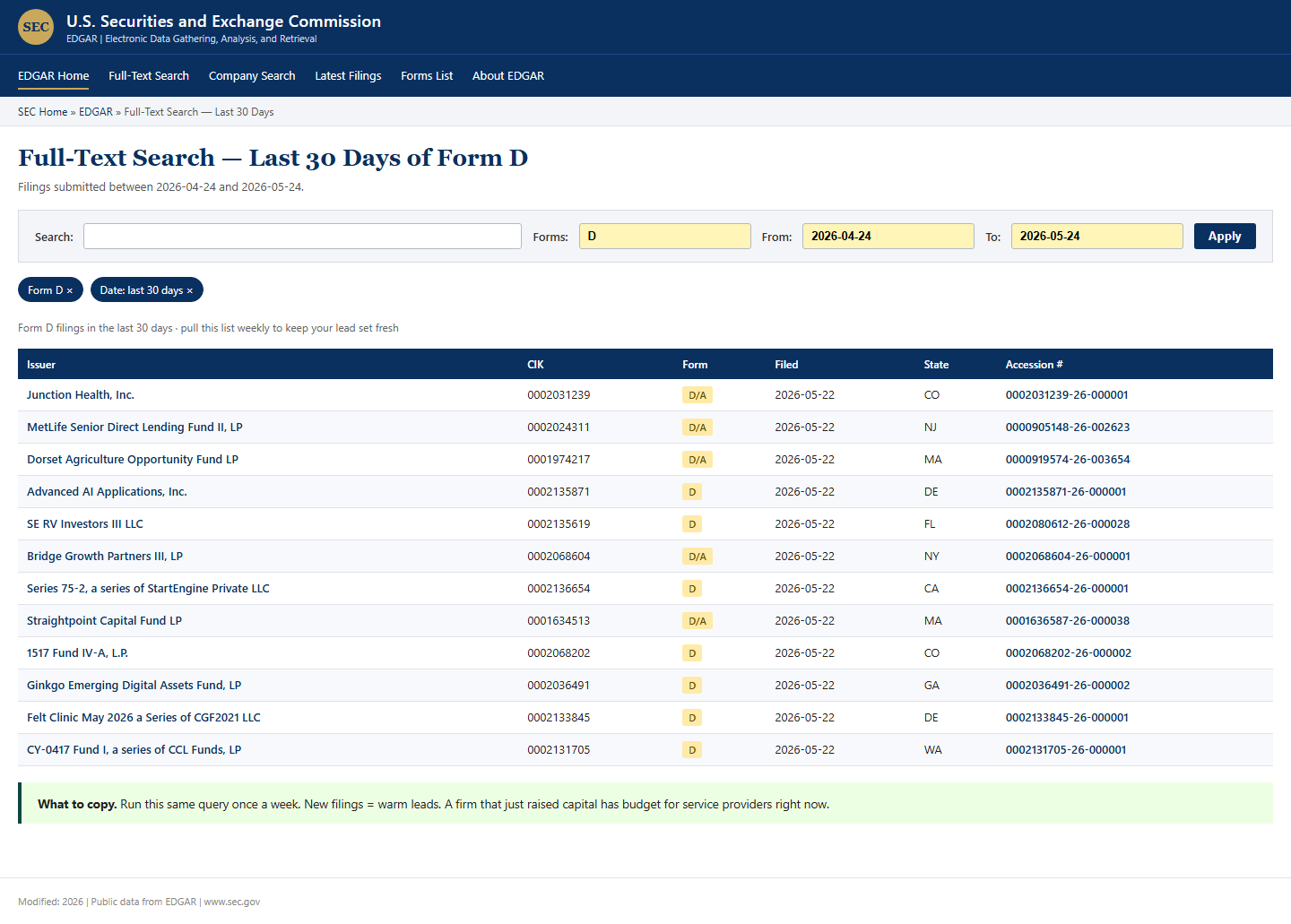
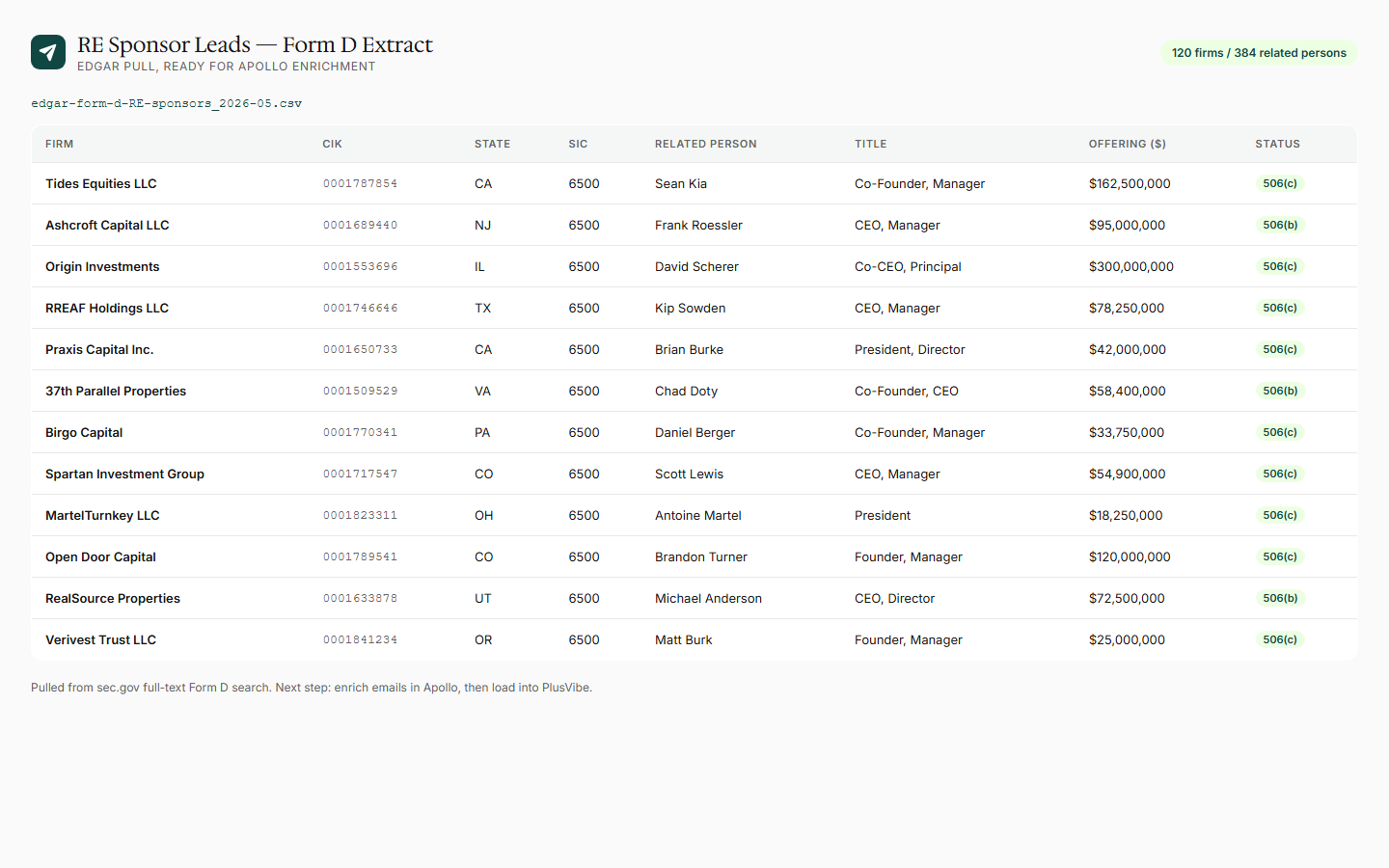
Export to CSV, then enrich and load
sec.gov/edgar.shtml — EDGAR landing. sec.gov/forms/secforms.htm — SEC forms list. SEC EDGAR Form D Filer Manual. EDGAR Full-Text Search API. SEC Investor Bulletin: Private Placements. Rule 506 of Regulation D. All filings and CIKs cited here are live on EDGAR; data pulled May 2026.
Every term, defined plainly
- Accredited Investor
- A high-net-worth investor who meets one of the SEC's wealth or licensing tests: $200K personal income (or $300K joint) for the last two years, or $1M net worth excluding primary residence, or holds a Series 7, 65, or 82 license.
- CIK
- Central Index Key. A 10-digit number the SEC assigns to every entity (company, fund, person) that has ever filed with EDGAR. The CIK is the unique join key across every filing.
- EDGAR
- The SEC's public filing system. Holds every submission since 1993, free, with structured data plus the original signed PDFs.
- Form D
- A short notice filed within 15 days of selling securities under a Regulation D exemption. Required for almost every real estate syndication, fund, and SPV that takes outside capital from US investors.
- GP
- General Partner. The operator of a syndication or fund. The GP signs the Form D, raises capital from LPs, runs the deal, and earns a promote.
- LP
- Limited Partner. The passive investor in a syndication or fund. LPs put up the capital and earn a preferred return plus a share of profits.
- Reg D
- Regulation D under the Securities Act of 1933. A set of federal exemptions from the full registration requirement that lets companies raise private capital without going public.
- Related Persons
- The officers, directors, general partners, managing members, and promoters named on a Form D. SEC requires every Related Person be listed with full name, address, and role.
- Rule 506(b)
- The traditional private offering exemption. Unlimited size in dollars, up to 35 non-accredited investors permitted under strict disclosure rules, no general solicitation allowed (no ads, no podcasts, no public marketing).
- Rule 506(c)
- The post-JOBS-Act path. Unlimited size, accredited investors only, every investor must be verified accredited (not self-certified), and the sponsor can publicly advertise the raise everywhere.
- SIC Code
- Standard Industrial Classification. A US government taxonomy of business activity. Real Estate sits in the 6500 family: 6500 root, 6510 operators, 6512 building operators, 6552 developers, 6798 REITs.
- SPV
- Special Purpose Vehicle. A single-asset LLC or LP set up to hold one deal. Real estate syndicators typically file a new Form D per SPV per deal, which is why a single sponsor often shows up across many filings.